Your Newsletter Is Visible. That's Not The Same As Recognizable.
How founders can use AI to publish a consistent newsletter that builds authority, grows an email list they own and attracts clients without sounding like everyone else.


Listen to the audio here:
In an internet fogged in with AI-generated sameness, a newsletter builds authority only when it’s both consistent and unmistakably yours. So the smart use of AI is to keep it publishing on rhythm while you supply the stance only you can sign.
Here’s what that looks like, starting with a lighthouse.
Being Seen Wasn’t Enough
In the 1800s, a captain coming up the California coast at night could see plenty of lights. What he needed to know was which one he was looking at. So every lighthouse was given its own flash pattern, its characteristic.
Pigeon Point was first lit on November 15, 1872, with one white flash every ten seconds. It still flashes that way today. The lamp burned lard oil, then kerosene, then electricity. The great clockwork the keepers wound by hand gave way to an automated LED. The flash never changed.
“Be the light they can name.”
Why Do So Many Newsletters Sound The Same?
Because the coast is crowded. A 2025 study by the SEO firm Graphite found AI-generated articles briefly outnumbered human-written ones in late 2024, and the two have run about even since. Roughly half of what’s published is now mostly machine-written.

There’s a reason it all sounds alike. A language model writes by predicting the likeliest next word. Its natural home is the average, and the average is where signatures go missing.
Meanwhile buyers have pulled inward. Edelman’s 2026 Trust Barometer named the mood insularity: only 22% of people said they trust someone meaningfully different from them. I call it the trust recession. Your buyer isn’t browsing for strangers to believe. They’re listening to the few voices already inside their circle.
What Does It Cost To Go Quiet?
More than most founders think. In the 2026 Edelman-LinkedIn B2B Thought Leadership Impact Report, 59% of final decision-makers said poor or absent thought leadership contributed to a vendor being cut. Those vendors never got a rejection email. They simply weren’t there when the buyer looked.
And most founder newsletters do go quiet. Issue one is lovely. Issue three is late. Then a busy quarter, and the light goes dark for months. A lighthouse that flashes only when the keeper feels inspired is a hazard. Ships stop trusting it.
Why Email Still Matters (And Why Followers Aren’t Enough)
Your social followers are a lease. The platform owns the land and the dial. Your email list is a deed.

Email still pays: Litmus’s most-cited figure is an average $36 return for every $1 spent. And it travels where you can’t. Edelman and LinkedIn found 89% of decision-makers who share thought leadership do it privately, through email, DMs, work chats and meetings.
Lens, Lamp, Landfall: How The Agent Splits The Work
A newsletter has two jobs: rhythm and signature. AI is excellent at the first. So I give the agent three phases, named after a lighthouse, and I keep the signature.
Lens: find the flash. In 1822 Augustin Fresnel built a lens of prism rings that bent one lamp’s scattered light into a beam visible twenty miles out. A stance does that for your ideas. The agent proposes possible stances from my source material, runs each through what I call the anyone test (could anyone in my industry have written this, word for word?), pulls a cleared client story from my vault and checks the draft against my own voice. I choose the stance.
Lamp: keep it lit. The Iconic Edge publishes every Wednesday after the show. That’s my characteristic. The agent drafts the issue from the episode, writes ten Notes, preps the LinkedIn cross-post, embeds the replay and podcast and schedules the week. I read every word and write the paragraph only I could write.
Landfall: bring them in. Every new subscriber gets a welcome sequence: what I believe, three issues to start with and one question to reply to. Free issues stay generous. Iconic Edge Insiders ($17/month or $170/year) is for readers who want me closer. [KONI: confirm live] Every issue carries one door in the P.S., matched to the week’s topic. And every issue is tagged by theme for the book it’s becoming. Fifty-two issues at about a thousand words is roughly 52,000 words.
“The agent never signs the byline.”
Does A Newsletter Actually Bring In Clients?
Yes, and without pitching. Edelman and LinkedIn asked what most increases trust in a company. 56% said showing a clear understanding of the buyer’s challenges. 14% said product strength. A newsletter is understanding, practiced in public, weekly. The readers who are ready walk through the door in the P.S. The rest keep reading until they are.
This is an old playbook. In 1787 and 1788, three men published 85 essays in New York newspapers under one pen name, arguing a position plenty of readers opposed. In 1788 those essays became a book, The Federalist. It’s still in print.
And human light still wins in the machines. Graphite found 86% of articles ranking in Google and 82% of articles cited by ChatGPT and Perplexity were written by people.
Find Your Flash
Grab The Light Characteristic, a one-page worksheet: your stance, your rhythm, the anyone test and the nine steps, with what the agent handles and what you decide. If you’re reading this, you’re already subscribed, so it’s in your welcome email. Forward this issue to a founder who needs it and it’ll be in theirs.
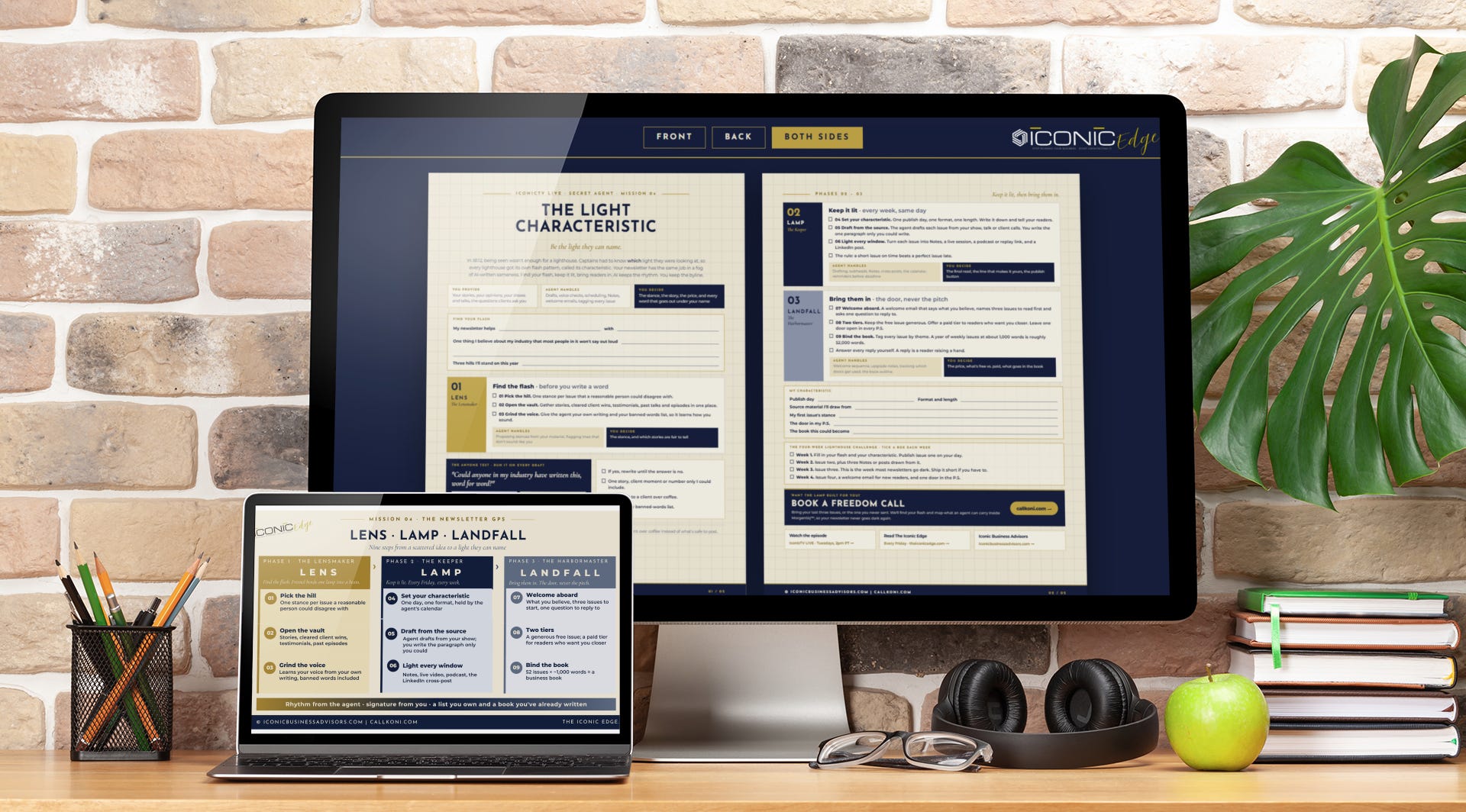
Already a subscriber: search your inbox for “Welcome to The Iconic Edge.”
New here: Subscribe free at TheIconicedge.com.
Want me closer: Iconic Edge Insiders, $17/month or $170/year.

P.S. Reply with one sentence you believe about your industry that most people in it won’t say out loud.
I read every reply, and a few may become next month’s issue (with your permission).

Love this. Visible and recognizable are so not the same thing, and I post every day and I still have to catch myself sounding like everyone else.