



Listen to the audio here:
An AI agent is only worth the work it finishes. That makes cost per completed outcome the one number that tells you whether AI is paying off, and it makes agent count and token price two of the most misleading numbers in your business right now.
Let me show you why with a wall.
The Man With 150 Agents
Someone told me last week he had 150 AI agents. He said it with the posture of a man describing his boat.

I asked what they finished yesterday.
He talked about platforms for six minutes. Orchestration layers. Which model he’d picked. How many workflows were “live.” I waited for a booked estimate, a paid invoice, a customer who got an answer before lunch. It never came.
I don’t think he was lying. I think he didn’t know. And I think a lot of owners are in the same spot, with a smaller number.
Why A Physicist Says You Did Zero Work
Walk up to a wall and push it for an hour. You’ll sweat. Your shoulders will burn. You’ll go home tired.
A physicist will tell you that you did zero work.
In physics, work is force times distance, times the cosine of the angle between them. If the wall doesn’t move, the distance is zero, and zero times any amount of effort is still zero. The angle matters too. Push down on a desk from above and you can strain all day without moving it an inch across the floor.
Map that onto AI:
Force is the AI itself: agents, models, tokens, compute. It’s what the market sells, and it gets cheaper every month.
Distance is the finished business outcome. A booked appointment, a closed-out job file, an invoice that got paid.
The angle is the design: whether the force is pointed at the outcome or somewhere next to it.
Patchwork AI tends to be enormous force at a bad angle with very little distance. That’s the business with 37 agents and the same to-do list it had in March.
Tokens Got Cheaper, But The Bill Keeps Rising

This is the question I’d most like every owner to ask, because the answer surprises people.
In a McKinsey Quarterly interview published in July, the CEO of Pay-i, a firm that tracks AI costs for enterprises, said inference prices for a fixed model size have dropped roughly 86% since 2022. In the same conversation he said the cost per completed task has risen steadily in every workload they see.
The fuel got cheaper and the trips got longer.
Agents don’t make one trip. They re-read the full customer history on every step. They draft, check themselves, retry, and hand off to another agent that checks again. The research McKinsey cites puts agentic tasks at roughly 1,000 times the tokens of a simple chat, with about 60% of the cost going to refining answers rather than producing the first one.
The line from that interview worth taping to your monitor:
“Tokens are not value. Tokens are the bill.”
The Three-Cent Job And The Five-Dollar Job
Some illustrative napkin math, using public list prices.
A well-designed workflow that uses about 8,000 input tokens and 1,500 output tokens per finished item, on a mid-tier model, costs around three cents per item. Ten thousand finished items a month comes to about $310.

Now run the same job without discipline. It re-sends 80,000 tokens of context, takes six passes instead of one, runs every pass on a premium model, and has a second agent review each result. Same job, same outcome, about $5.25 per item. At ten thousand items, that’s over $50,000 a month.
Nobody decided to spend that. It accumulated one retry at a time, because nobody set a ceiling on what one finished outcome was allowed to cost.
What’s Under The Waterline
The token is the visible part of the iceberg. Underneath sit the costs that rarely make it into an AI budget: bad data, repeated context, premium models doing clerical work, duplicate agents with overlapping jobs, broken handoffs between them, and the most expensive line of all, the human who cleans up afterward.
G2’s 2025 survey of more than 1,000 B2B software buyers found that 63% said their agents needed more human oversight than they expected. That oversight is real cost. It just lands on your calendar instead of your invoice.
The Five Questions Every Agent Should Answer
Before an AI agent gets a login in your business, it should be able to answer these:
What finished outcome does it own?
What systems and data can it touch?
What can it decide on its own?
When does it stop and hand the work to a human?
What does one completed outcome cost, and what’s the ceiling?
If you can’t answer them, you don’t have an AI workforce yet. You have AI experiments with a monthly invoice.
And someone has to keep checking the answers. Regular readers know I call that role the Verifier: the honest system that tells you when something didn’t work as plainly as when it did. The Verifier is the one standing next to the wall with a tape measure.
What It Looks Like When The Wall Moves
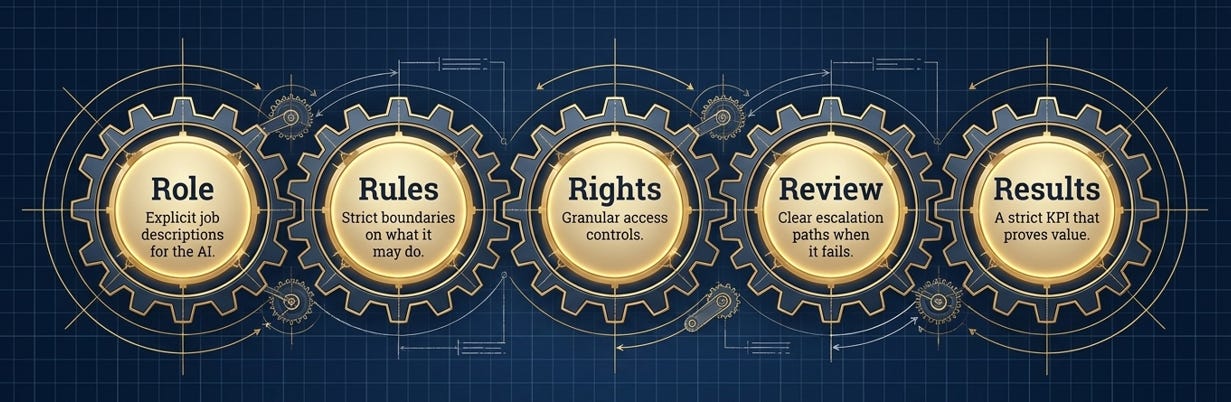
The companies getting real money out of AI aren’t the ones with the most agents. McKinsey’s 2025 global survey found only about 6% of organizations were seeing meaningful EBIT impact from AI, and those high performers were roughly three times more likely to have fundamentally redesigned their workflows. They fixed the angle before they added force.
Picture your Monday morning that way. The weekend leads were answered. The estimates got followed up. Customers got their update before they had to ask. Job files closed out, invoices moving, and beside each one, what it cost to finish. You’re not holding the wall anymore. You’re choosing which wall moves next.
Where To Start
Start at the wall.
For most owners, the wall is the work still routing through them: the approvals, the exceptions, the questions only they can answer. I built a short quiz called the Owner Dependency Index to measure exactly that.
It takes a few minutes, it’s free, and it shows you how much of your business still depends on you personally, which is usually where the first AI role should go.
If you want to see the entire LIVE training here, click the image below now.

P.S If you already know where your wall is, book a Freedom Call.
No slides, no pressure. Bring one workflow that keeps landing on your desk, and we’ll work out what it should cost to finish it, per outcome, before you spend a dollar on another agent.

The wall thing is doing a lot of work here and I mean that as a compliment — force times distance is a genuinely mean way to describe a man with 150 agents and no booked estimate. "Tokens are the bill" is the line I'd keep too. My one quibble: the physicist answer is technically right and socially useless, which is roughly how most cost dashboards arrive in a small business.