



Listen to the article here:
Most AI Projects Were Doomed Before They Started
There’s a strange pattern happening in boardrooms right now.
Executives are pouring millions into AI initiatives with the same energy companies once poured into “digital transformation,” blockchain, or the metaverse. Every leadership meeting suddenly includes phrases like:
“We need an AI strategy.”
But behind the presentations, pilot programs, and press releases, there’s a reality very few people talk about openly:
Most AI projects fail.
Not because the technology doesn’t work.
But because businesses misunderstand what AI actually is.
And more importantly, what it requires.
The problem is that companies approach AI like they’re buying a luxury car — when in reality, they’re rebuilding an entire highway system underneath the business.
That difference changes everything.
The AI Fantasy Most Companies Believe
There’s a seductive myth in the AI world:
That success comes from finding the “perfect model.”
The smartest algorithm.
The newest tool.
The most advanced platform.
But that’s rarely where projects break.
Most AI failures happen long before the model even matters.
Because AI is not magic.
It’s infrastructure.
And infrastructure exposes every crack in an organization.
Messy workflows.
Fragmented systems.
Bad data.
Internal politics.
Fearful employees.
Undefined goals.
AI doesn’t hide dysfunction.
It magnifies it.
Hard Truth #1: AI Is Mostly a Data Problem
Most executives imagine AI development as engineers building futuristic models.
The reality is far less glamorous.

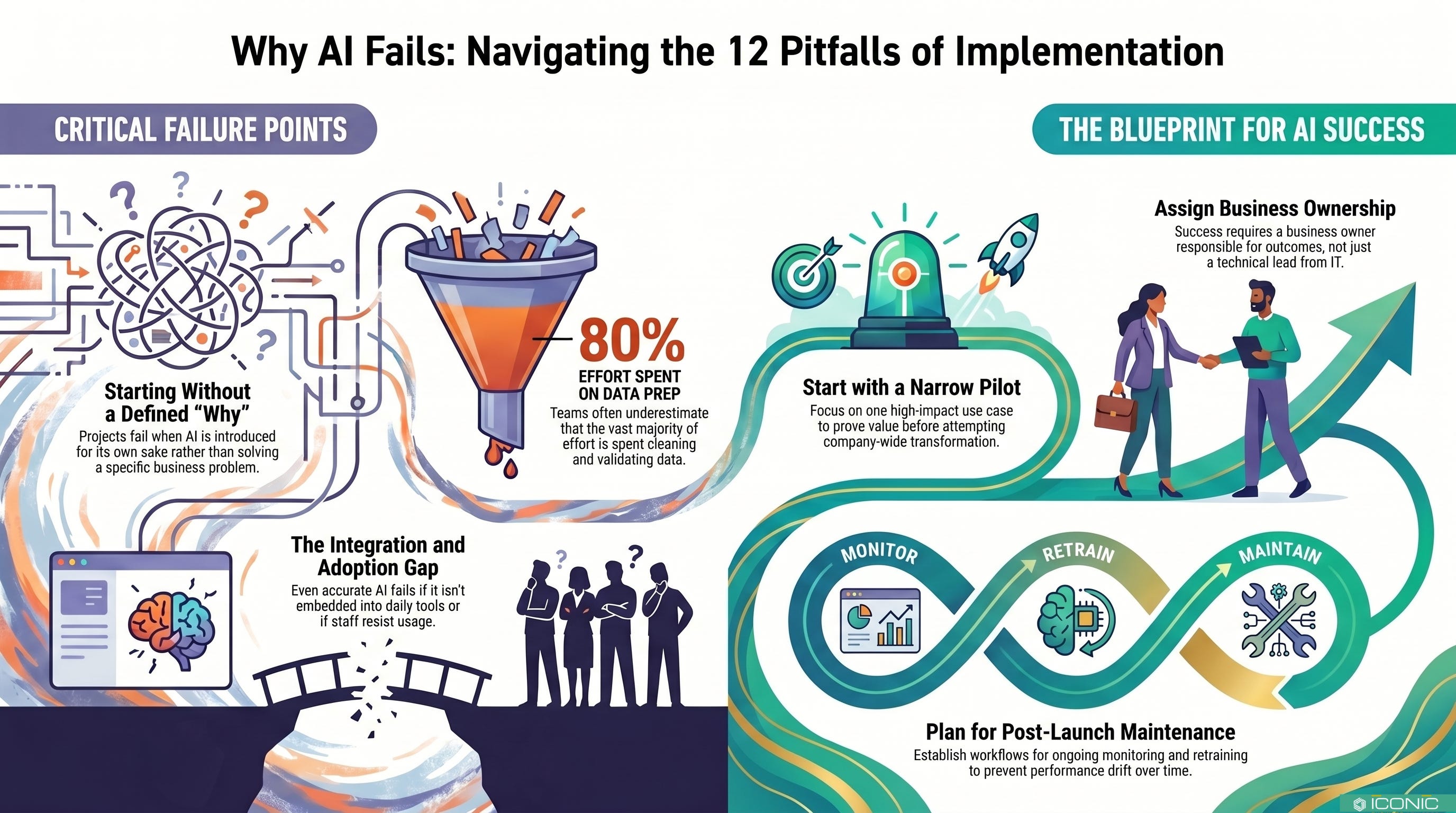
The majority of the work is cleaning data.
Organising it.
Labelling it.
Fixing inconsistencies.
Connecting systems that were never designed to speak to each other.
In many projects, 60–80% of the effort goes into preparing and maintaining data pipelines.
That means the “AI project” often becomes a data governance project in disguise.
And this is where organizations hit the wall.
Because many companies discover their data is:
✅ trapped in silos,
✅ poorly documented,
✅ inconsistent,
✅ legally restricted,
✅ or simply unusable.
It’s like trying to build a Formula 1 car while pouring contaminated fuel into the engine.
No matter how advanced the model is, the output will fail if the foundation is broken.
Hard Truth #2: AI Cannot Fix a Broken Business Process
One of the biggest mistakes companies make is trying to automate chaos.

A process already filled with confusion, exceptions, and manual workarounds suddenly gets AI layered on top of it.
Leadership expects efficiency.
Instead, they scale dysfunction faster.
It reminds me of a quote about technology:
“Automation applied to an inefficient operation magnifies the inefficiency.”
AI is the ultimate multiplier.
If your workflows are clear, optimized, and documented, AI becomes transformational.
If your workflows are messy, AI becomes expensive confusion.
This is why successful AI adoption often starts with something surprisingly unsexy:
Documentation.
Not prompts.
Not models.
Not dashboards.
Documentation.
Because before automation comes clarity.
Hard Truth #3: Launch Day Means Almost Nothing
Most companies treat AI deployment like a software launch.
Build it.
Deploy it.
Move on.
But AI doesn’t behave like traditional software.
It behaves more like a living organism.
Over time, the real world changes customer behaviour shifts, market conditions evolve, language changes, and patterns drift.
And slowly, silently, the model begins degrading.
At first, nobody notices.

Then accuracy drops.
Trust erodes.
Employees stop using it.
Executives lose confidence.
The dangerous part is that these failures are often invisible until serious damage is already done.
AI systems require continuous monitoring, retraining, and adjustment.
Not occasionally.
Constantly.
The companies succeeding with AI understand something critical:
AI is not a one-time implementation.
It’s an ongoing operational commitment.
Hard Truth #4: The Biggest Problem Is Usually Human
Ironically, most AI failures are not technical failures.
They’re cultural failures.
Employees fear replacement.
Managers resist change.
Teams distrust outputs.
Departments protect territory.
And quietly, resistance spreads.
Sometimes people openly reject the system.
More often, they simply ignore it.
Which creates a dangerous illusion:
the AI technically “works,” but nobody actually uses it.
That’s why ownership matters so much.

The best AI projects don’t belong solely to IT departments or outside consultants.
They have a business owner.
Someone accountable not just for technical performance, but for business outcomes and adoption.
Because successful AI implementation is ultimately about behavior change.
Not code.
Hard Truth #5: Companies Think Too Big Too Fast
There’s a dangerous tendency in AI strategy:
Trying to transform everything at once.
Entire-company rollouts.
Massive multi-department automation.
Complex interconnected use cases.
It sounds ambitious.
But ambition without focus becomes paralysis.

The best AI projects usually begin small.
Very small.
Not:
“Use AI to transform customer experience.”
But:
“Reduce customer support response times by 20%.”
Not:
“Modernize logistics.”
But:
“Reduce warehouse idling by 15%.”
The difference is clarity.
If success cannot be measured quickly and specifically, the project becomes impossible to evaluate.
And when organizations can’t prove value early, executive support evaporates fast.
The Real Reason AI Projects Collapse
Underneath all of this lies one core misunderstanding:
Companies think they are implementing technology.
But they are actually redesigning systems.

AI changes workflows, communication, accountability, decision-making, operations, and even company culture.
That’s why the organizations succeeding with AI are not necessarily the most technologically advanced.
They’re the most operationally disciplined.
From AI Adoption to AI Integration
The companies winning with AI have stopped asking:
“How do we use AI?”
Instead, they ask:
“What business problem are we solving?”
That shift sounds subtle.
But it changes everything.
Because successful AI isn’t about adding another tool.
It’s about embedding intelligence into the flow of work itself.
Inside the CRM.
Inside customer support.
Inside operations.
Inside decision-making.
Invisible.
Practical.
Integrated.
The best AI implementations barely feel like AI at all.
They simply feel like a business operating better.
The Companies That Win Will Be the Ones That Simplify
The future of AI probably won’t belong to the loudest companies.
Or the ones spending the most money.

It will belong to the organizations disciplined enough to:
✅ fix their foundations,
✅ simplify their processes,
✅ train their people,
✅ and focus relentlessly on measurable outcomes.
Because eventually, the hype fades.
And when it does, only one question remains:
Did the AI actually solve a real business problem?
That’s the difference between innovation and expensive theater.
